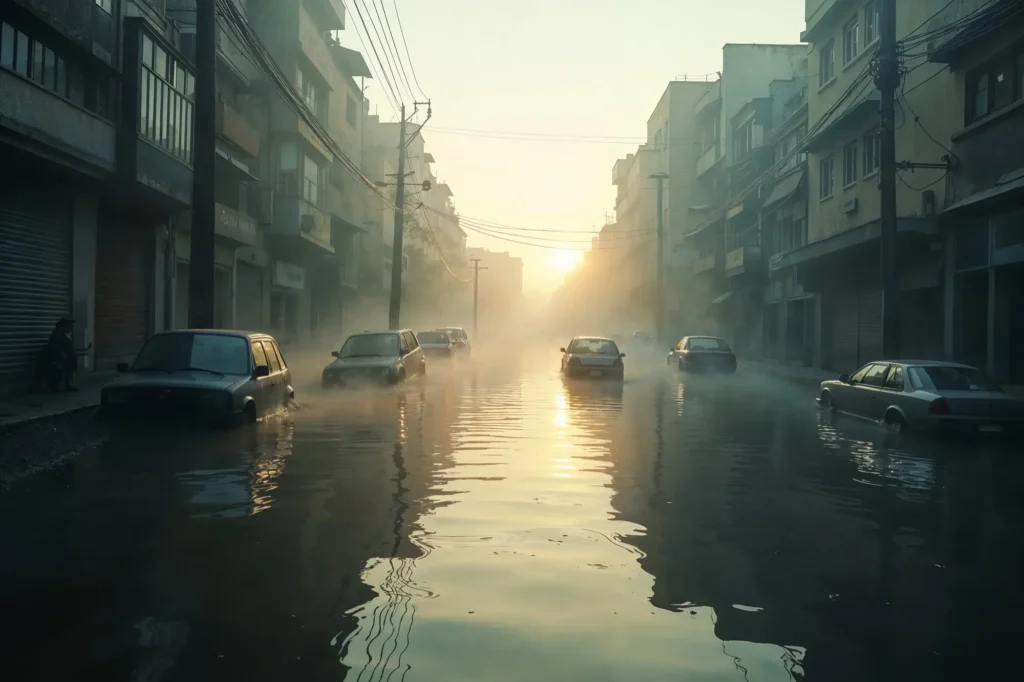
Does it ring a bell?
You don’t have to imagine anymore, you just need to empathize. Yes, very right. The family from Swat, that we all saw drowning on our social media pages. How one morning a picnic adventure turned into a tragedy. That harrowing image would forever haunt our nation.
It could be me; it could also be you and your family! Afterall, how seriously do we take these flood warnings? “Oh, it’s just another bulletin, another farfetched forecast” “Nothing will happen, don’t worry, they exaggerate”
Don’t we all, or most of us, react to such news in the similar fashion? At this point, we need
serious introspection as well, a ‘soul-search’ of who we are as a nation? In Gen Z’s terms, “are
we gaslighting the issues?” or are we ready to address them from the front?
Of course, we can always scrutinize ‘how a news should be broken to the audience” or what are
better ways to sensitize the public about impending disasters, but first we have to prepare
ourselves to receive it in its full form, to not put it on ‘deaf ears’.
We need to build a culture that doesn’t burry these warnings under the carpet on the name of “keeping faith” or “all will be well, eventually”. Whole societal discourse about disasters needs to be revisited and revised.
All will not be well, eventually, unless you make it “well”. It’s an ‘ongoing work’ that needs effort from all fronts, not just government.
How we talk about disasters shapes how we respond to them: it all starts from public narrative, and no popular public narrative just emerges overnight, it is embedded in small, daily conversations that we have with each other.
Next time when we see a flood warning on the television screens, instead of brushing it off in public gatherings and mocking people who are “too careful”, can we rather tell each other:
“Be careful, I heard there’s a flood coming” “Let’s reschedule our trip to some other time” “Let’s not take that route for travelling”
“Let’s pack extra essentials for everyone”
Little things matter the most: everyday conversations, small gestures and short-term changes that are exercised with consistency result into a better long term.
In 2025, the pictures of flooded villages and makeshift camps were all over our screens. Yet beyond the tears and headlines lies a deeper truth: the resilience of communities who share food, open homes, and rebuild from ruins.
Pakistan’s rescue and relief response was instant — led by the army, provincial authorities, NGOs, and thousands of volunteers. But our public narrative must highlight agency; “will to do something” not just agony. It must show that recovery is not charity; it’s a partnership between government, citizens, and global allies.
Look around yourselves, not very far; that mosque around the corner, that frequently used ‘WhatsApp group”, your last post on Instagram, that tweet that got most retweets, your office staff room, your student cafeteria, your classroom dialogues, the exchange you had with the
shopkeeper, your cab driver or that public building’s guard, it can all add up to something
impactful. Watch it.
Once we have consciously and deliberately worked on the tone of our inner monologue and societal discourse, we might be able to free ourselves from the deadly claws of social conditioning, that dictates our response to climate change and catastrophes.
We need to wake up to the reality that climate change is not a concern for future, it’s very much happening as I write and you read it. It’s as real as the sky that you look at; it’s everchanging. So there is no room for reacting later, we have to act now.
After all, we may not be able to control, ‘what happens to us’ but we can always choose how to respond to it.