Women Entrepreneurs in Pakistan: Progress, Barriers, and the Road Ahead
Women’s entrepreneurship in Pakistan has witnessed significant growth in recent years, driven by the rise of online businesses and home-based enterprises. This trend is both socially encouraging and economically promising. However, despite visible progress, women entrepreneurs continue to face deeply rooted structural, cultural, and financial barriers that limit their full potential.
At both global and national levels, several institutions have introduced policies to enhance women’s financial inclusion. For instance, the World Bank’s Resilient and Accessible Microfinance (RAM) project highlights that only a small fraction of potential women borrowers currently have access to microfinance services. Similarly, the Securities and Exchange Commission of Pakistan (SECP) introduced the Women Equality in Finance Policy (WEFP) in 2024 to improve women’s access to formal financial services. While these initiatives reflect positive reform efforts, the journey toward true equality remains long.
Challenges Facing Women Entrepreneurs
Limited Access to Finance
Financial exclusion remains the most significant obstacle for women entrepreneurs. Although the State Bank of Pakistan’s equality banking policies increased women’s active bank accounts to 37 million by mid-2025, the gender gap in financial inclusion still stands at 30%.
While women’s participation in microfinance has increased, access to credit for women-led SMEs remains limited. The 2025 WECON Policy Report reveals that only 1% of Pakistani women are entrepreneurs, and just 3.2% of SME loans in 2022 were allocated to women-owned businesses. Cultural norms, lack of collateral, and complex banking procedures discourage many women from seeking formal financing. According to WECON, 91% of women hesitate to use institutional financing channels.
Institutional Reforms and Microfinance Impact
To address underrepresentation, SECP’s WEFP mandates a minimum of 25% female representation on non-bank microfinance institution boards. Microfinance has emerged as a powerful empowerment tool. The World Bank-supported $102 million RAM program has benefited 1.89 million individuals, with over half being women from rural and climate-vulnerable regions.
Data from the Kashf Foundation further demonstrates impact:
- 4 out of 10 micro-borrowers report reduced household poverty.
- 9 out of 10 report increased business income.
Digital Inclusion and Modern Business Growth
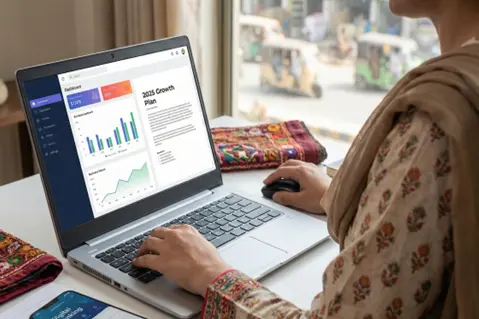
The digital revolution has become a game changer for women entrepreneurs. According to the 2025 Visa–HBL Women SMB Digitization Index, 51% of revenue generated by women-led small businesses now comes from online sales, while 10% operate entirely cashless. Nearly half of these entrepreneurs use AI-based tools such as ChatGPT and data intelligence platforms to expand customer reach. Additionally, SBP Governor Jameel Ahmad noted that financing for women in agriculture and SMEs has increased 1.5 times since 2021, signalling a positive shift.
Beyond Finance: Deeper Structural Barriers
Access to finance alone is not enough. Many women lack financial literacy, having limited exposure to budgeting, credit management, and calculated risk-taking. Integrating financial education into schools and higher education institutions is essential. Moreover, cultural resistance, workplace harassment, and the tendency to judge women based on appearance rather than capability continue to hinder progress. True empowerment requires safe, ethical, and accountable work environments where women can thrive without fear or bias.
Conclusion
Closing the gender gap in entrepreneurship has the potential to inject billions of rupees into Pakistan’s economy. While initiatives like RAM and WEFP are promising, deeper systemic challenges such as limited credit access, cultural constraints, financial illiteracy, and workplace safety must be addressed.
As digital inclusion expands and gender-sensitive policies are strengthened, investing in women’s skills and capabilities will enable women entrepreneurs to play a transformative role in Pakistan’s sustainable and inclusive economic growth.