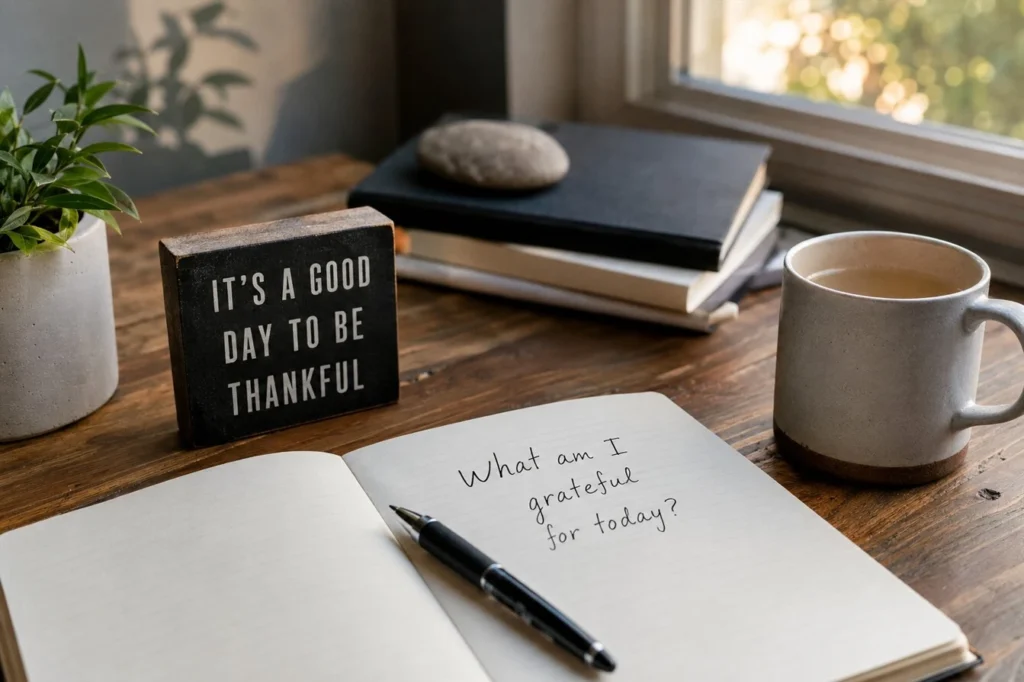
There's a moment most of us know well: you get to the end of the day, someone asks "how was it?", and you say "fine." Not bad, not great — just fine. Forgettable.
Then, once in a while, a totally ordinary day sticks with you. Maybe a stranger held the door a beat longer than they needed to. Maybe your coffee was exactly right. Maybe a friend texted "thinking of you" for no reason at all. Nothing life-changing happened — and yet somehow, that day stayed.
What made the difference wasn't the day. It was your attention. Your brain is wired to miss the good stuff
This isn't a willpower problem or a personality flaw. It's biology. Our brains evolved with a strong negativity bias; a built-in tendency to notice threats, problems, and things that could go wrong far more readily than things that are simply going right. That bias kept our ancestors alive. It also means, by default, a broken zipper gets more mental real estate than ten things that quietly worked out fine.
Gratitude, in this light, isn't about "staying positive" or pretending things are better than they are. It's a deliberate correction; a way of nudging attention back toward things your brain would otherwise scroll right past.
The science, without the overselling
Research on gratitude journaling has repeatedly linked the practice to improvements in mood, and even sleep quality. That's genuinely useful but it's worth being honest about the limits too. Gratitude isn't a cure-all, and studies also show that forced gratitude, the kind where you're mentally checking a box because you feel you should, tends to fall flat. The benefit comes from noticing something real, not from performing positivity.
That distinction matters more than most gratitude advice admits.
A better question than "What are you grateful for?"
The classic prompt i.e. list three things you're grateful for, is fine, but it's also vague enough to feel like homework. Big, abstract gratitude ("my health," "my family") is true, but it rarely produces the small jolt of attention that actually shifts your mood in the moment.
Try this instead, once a day:
"What's one thing today that went better than it had to?"
Notice what this does differently:
● It's specific. Not "my life," but one thing, from today.
● It's low-pressure. A good cup of coffee counts. So does a green light on a day you were running late.
● It trains attention, not performance. You're not proving you're grateful; you're just noticing.
Over time, this small shift compounds. You start scanning your day differently, almost without meaning to; not ignoring what's hard, just also catching what isn't.
What this looks like in practice
Imagine someone who's had a genuinely rough week; deadlines piling up, a canceled plan, a bad night's sleep. They're not about to write "I'm grateful for my career" and mean it. But at the end of one particularly frustrating day, they ask themselves the question anyway: what went better than it had to? And they land on something small i.e. a coworker covered for them for ten minutes so they could take a breather. That's it. Not a transformation. Just one true, specific thing.
Do that daily for a week, and something interesting tends to happen: it's not that the hard week gets easier. It's that the hard week stops being the only thing you remember about it.
One honest caveat
Gratitude is not the same as toxic positivity. Noticing something good today doesn't mean pretending everything is fine, and it definitely doesn't mean skipping over real pain to get to a silver lining. The practice above works precisely because it's small and specific — it sits alongside the hard stuff, not on top of it.
Try It for Seven Days
No journal required. No app. Just one question, once a day, ideally right before you go to sleep:
What's one thing today that went better than it had to?
Give it a week. You may not feel radically different but you might notice you're paying attention to a slightly different life than the one you thought you were living.