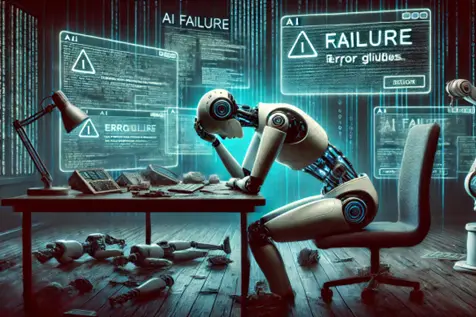
Artificial Intelligence (AI) has been widely promoted as the driving force behind the next industrial revolution. From automating repetitive office tasks to transforming decision-making processes, businesses across industries have rapidly integrated AI into their operations. Organizations are increasingly embracing AI to streamline workflows, improve efficiency, and reduce reliance on human labor. However, as companies continue replacing human involvement with AI systems, a critical reality is becoming more evident: AI cannot fully replace the value, judgment, and adaptability that humans bring to the workplace.
The Rise of the AI Hype
Over the past few years, AI has evolved at an extraordinary pace. What was once a specialized area of interest for computer scientists and machine learning researchers has now become a central focus for businesses worldwide. Many organizations view AI as the future of automation and believe that advanced AI models can eventually replicate or even replace human cognitive decision-making.
This optimism has fueled an aggressive push toward AI adoption. Businesses have quickly incorporated AI tools into everyday workflows and often require employees to use AI systems regularly. Yet despite this enthusiasm, practical limitations and challenges are becoming increasingly difficult to ignore.
The Reality Gap: AI vs. Human Capability
Although AI promises seamless automation, the reality often looks very different. Rather than eliminating work, AI frequently requires continuous oversight, supervision, and adjustment from human employees. AI systems operate through machine learning models that recognize patterns in data, but they do not genuinely understand context, meaning, or human nuance. As a result, they often struggle in complex business environments where judgment and contextual understanding are essential.
Even simple tasks such as data handling and formatting can become problematic. AI systems may misinterpret inputs, produce incorrect calculations, or generate formatting errors. Instead of reducing workload, these mistakes often create additional responsibilities for employees who must verify, correct, and manage AI-generated outputs.
As a result, organizations frequently discover that AI cannot operate independently and still requires substantial human involvement. This challenges the popular narrative that AI will fully replace human supervision and decision-making.
The Problem of AI “Hallucinations”
One of the most concerning issues emerging from widespread AI use is the phenomenon known as AI hallucination. This occurs when AI systems generate false or fabricated information that has little or no basis in reality. What makes this issue particularly troubling is that AI models often present inaccurate information confidently and authoritatively. Because AI responses are designed to sound convincing, distinguishing factual information from fabricated content can become difficult.
In business environments, AI hallucinations can lead to misleading reports, inaccurate analytics, and flawed decision-making. Consequently, organizations still require human oversight to verify information and prevent potentially costly mistakes.
Legal and Ethical Challenges
Beyond technical limitations, AI companies are facing increasing legal and ethical scrutiny. Many AI systems are trained on enormous datasets gathered from publicly available information, often without the explicit consent or knowledge of content creators and rights holders. Concerns surrounding the use of copyrighted materials have generated significant debate and legal action. Numerous AI models have allegedly been trained using copyrighted content, raising questions about ownership, intellectual property rights, and fair use practices.
As legal challenges continue to grow, AI companies are increasingly facing lawsuits and regulatory pressure. These concerns may become a defining issue for the future development and commercialization of AI technologies.
Conclusion
Despite claims that AI represents the future of both technology and the workforce, it remains far from being a complete solution for business automation. Its dependence on human oversight, inability to fully understand context, and tendency to generate inaccurate information reveal important limitations. AI undoubtedly offers significant potential and can serve as a valuable tool when used appropriately. However, businesses may soon need to reconsider how AI should be integrated into operations not as a replacement for human expertise, but as a technology that complements and supports it. As legal, ethical, and practical challenges continue to emerge, the AI industry may face a critical turning point in determining how these technologies are responsibly developed and deployed.