Artificial Intelligence has transformed the way we work, learn, and communicate. From students and researchers to professionals and business owners, people now use AI almost every day to solve problems, generate ideas, improve writing, analyse data, and complete tasks in a fraction of the time they once required.
What previously took weeks or even months can now be accomplished within hours. Reports are drafted in minutes, presentations are created instantly, emails are polished effortlessly, and complex information is summarised with remarkable speed. There is no denying that AI has made our work more efficient and our lives more convenient. It is one of the greatest technological breakthroughs of the modern era.
But perhaps this is where we need to pause and ask a more important question.
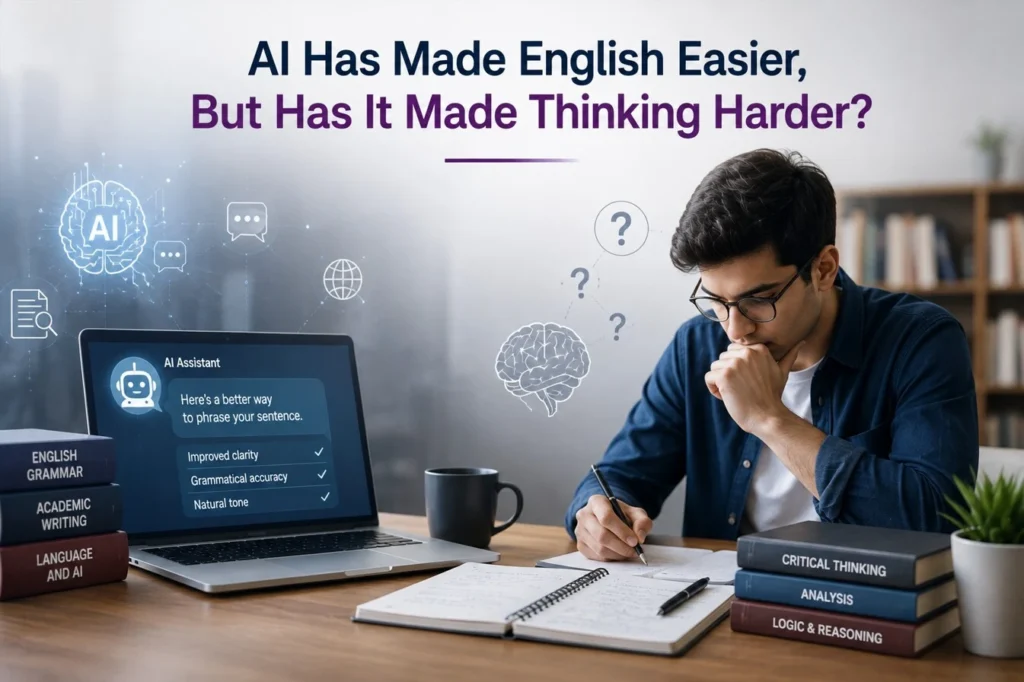
Has AI made English easier at the cost of making thinking harder?
For many students, AI has become an excellent writing assistant. It corrects grammar, improves vocabulary, organises ideas, and even produces well-structured essays. As a result, students are often able to submit polished work with minimal effort.
However, writing has never been only about producing grammatically correct sentences. Writing is a thinking process. Before words appear on a page, the mind observes, analyses, questions, evaluates, and creates. It is through this mental effort that critical thinking develops.
When students rely entirely on AI to generate ideas, organise arguments, and reach conclusions, they may produce better-looking assignments without actually engaging in deeper thinking. Instead of analysing a problem, they simply type a prompt. Instead of exploring multiple perspectives, they wait for AI to provide an answer. The task is completed, but the intellectual journey is often skipped.
This growing dependence can gradually change the way people approach learning. Rather than struggling with a difficult question, many now expect an instant solution. The habit of researching multiple sources, comparing viewpoints, and constructing original arguments is slowly being replaced by copying, editing, and submitting AI-generated responses. While the output may appear impressive, the learner may not fully understand the concepts behind it.
This trend is not limited to education. Professionals increasingly rely on AI to write reports, prepare speeches, draft proposals, and even make important decisions. While this undoubtedly improves productivity, it also raises an important concern: if AI consistently performs our intellectual tasks, will our own cognitive abilities become less active over time? Just as physical muscles weaken without exercise, our ability to think critically, reason independently, and solve complex problems may also decline if we stop challenging our minds.
This is not a criticism of AI itself. AI is a tool, and like every powerful tool, its impact depends on how it is used. Used wisely, it can stimulate creativity, save time, and support learning. Used carelessly, it can encourage overreliance, passive learning, and intellectual complacency. Perhaps the solution is not to avoid AI but to redefine the way we use it. Instead of asking AI to think for us, we should ask it to think with us. We should use it to generate ideas, explore different perspectives, challenge our assumptions, and refine our own work, not to replace the thinking process altogether. AI should be a collaborator that strengthens human intelligence rather than a substitute that weakens it.
The real danger is not that AI writes for us. The greater danger is that we gradually stop asking questions, challenging assumptions, and constructing our own arguments. Knowledge becomes easier to access, but understanding may become more difficult to develop.
Education has never been about finding the fastest answer. It has always been about learning how to think. The ability to reason, evaluate evidence, solve unfamiliar problems, and make independent judgements cannot simply be downloaded or generated by a chatbot. The future will not belong to those who merely know how to use AI. It will belong to those who know when to question it, when to verify it, and when to think beyond it.
AI should make our work easier, but it should never make our minds weaker