A recent scholarly exchange between researchers from the University of California, Irvine's Anteater Virtues Project and Superior University, Pakistan, highlights the growing need to broaden the intellectual horizons of character education by engaging diverse virtue traditions.
Character Education Beyond Cultural Boundaries
Across the world, educational traditions have long sought to cultivate moral excellence, responsible citizenship, and human flourishing. Confucian, Buddhist, Indigenous, Islamic, and other philosophical traditions all offer rich understandings of character development. However, many contemporary higher education initiatives remain concentrated within neo-Aristotelian frameworks.
Researchers examining global character education have observed that the relative absence of virtue-based programs in many non-Western universities is not due to a lack of conceptual resources. Rather, it reflects historical, institutional, and policy pathways that have shaped the development of higher education systems. The challenge, therefore, is not to export one model globally but to create meaningful dialogue between traditions.
Such dialogue becomes especially important as universities increasingly recognize that education must prepare students not only for professional success but also for ethical leadership, civic engagement, and societal contribution.
The Superior Leading with Character Project: A Distinctive Approach
At Superior University, character formation is approached through the Prophetic Leadership Character Model. While the model engages constructively with contemporary virtue ethics scholarship, its primary inspiration comes from the Prophetic tradition and the broader Islamic intellectual heritage.
This distinction is significant.
Rather than viewing character merely as the cultivation of discrete virtues, the Prophetic Leadership Character Model understands character development as the holistic mastery of the human self. Its central reference point is the life and example of Prophet Muhammad (peace be upon him), who is understood not simply as a model of virtuous behavior but as a comprehensive embodiment of human flourishing.
Within this framework, personal excellence cannot be separated from spiritual growth, ethical leadership, social responsibility, justice, compassion, service, and community development. Character is not an isolated individual achievement but a force that shapes institutions, communities, and societies.
This broader vision expands the conversation on virtue ethics beyond questions of personal morality toward questions of collective flourishing.
From Character Formation to Civic Flourishing
One of the distinctive contributions of the Superior Leading with Character Project is its integration of character education with civic development.
Many educational approaches treat character and citizenship as separate domains. Superior University's framework, however, views them as deeply interconnected. Individual flourishing, community flourishing, and societal flourishing are understood as mutually reinforcing realities.
The cultivation of virtues such as wisdom, justice, courage, compassion, trustworthiness, and responsibility is ultimately directed toward the common good. Character education therefore extends beyond self-improvement to encompass responsible citizenship, institution-building, ethical leadership, and social transformation.
This civic dimension is particularly evident in Superior University's work on the Ideology and Constitution of Pakistan. The initiative seeks to cultivate constitutional awareness, civic responsibility, and a strong sense of identity among students.
In this approach, ideology is not understood merely as a collection of political ideas. Rather, it is viewed as a worldview that provides meaning, purpose, identity, moral direction, and a framework for social life. Similarly, the Constitution is presented not simply as a legal document but as a collective social covenant that articulates rights, responsibilities, justice, and the ethical foundations of public life.
The objective is to nurture graduates who are not only knowledgeable professionals but also informed, responsible, and engaged citizens committed to justice and the common good.
Human Flourishing Through Intellectual and Civic Virtues
The conversation between the Anteater Virtues Project and Superior University reveals important areas of convergence.
Both initiatives share a concern for human flourishing and recognize the transformative role educational institutions play in shaping future generations. Both acknowledge that universities must develop more than technical competence; they must cultivate wisdom, responsibility, ethical reasoning, and civic engagement.
The Anteater Virtues Project focuses on intellectual virtues that enable individuals to pursue truth, knowledge, and understanding. The Superior Leading with Character Project complements this by emphasizing the integration of intellectual, moral, spiritual, and civic dimensions of human development.
Together, these perspectives point toward a more comprehensive understanding of flourishing, one that unites intellectual excellence with moral purpose and civic responsibility.
Beyond the Label of Neo-Aristotelianism
An important question emerging from this dialogue concerns how character initiatives outside the Western tradition should be described.
While scholars have sometimes categorized Superior University's work as "neo-Aristotelian," such a label may not fully capture its intellectual foundations. Although the Prophetic Leadership Character Model engages seriously with neo-Aristotelian scholarship and shares many common concerns regarding virtue and flourishing, its primary roots lie within the Prophetic tradition and Islamic conceptions of human development.
Therefore, it may be more accurate to describe the framework as a virtue-based and flourishing-oriented approach that enters into dialogue with neo-Aristotelian thought while drawing its central inspiration from an indigenous Islamic tradition of character formation.
This distinction is not merely terminological. It reflects a broader aspiration to enrich global conversations on character education by bringing diverse intellectual traditions into constructive engagement with one another.
Toward a More Inclusive Global Conversation
The future of character education in higher education may depend on our ability to move beyond intellectual silos and foster genuine cross-cultural dialogue.
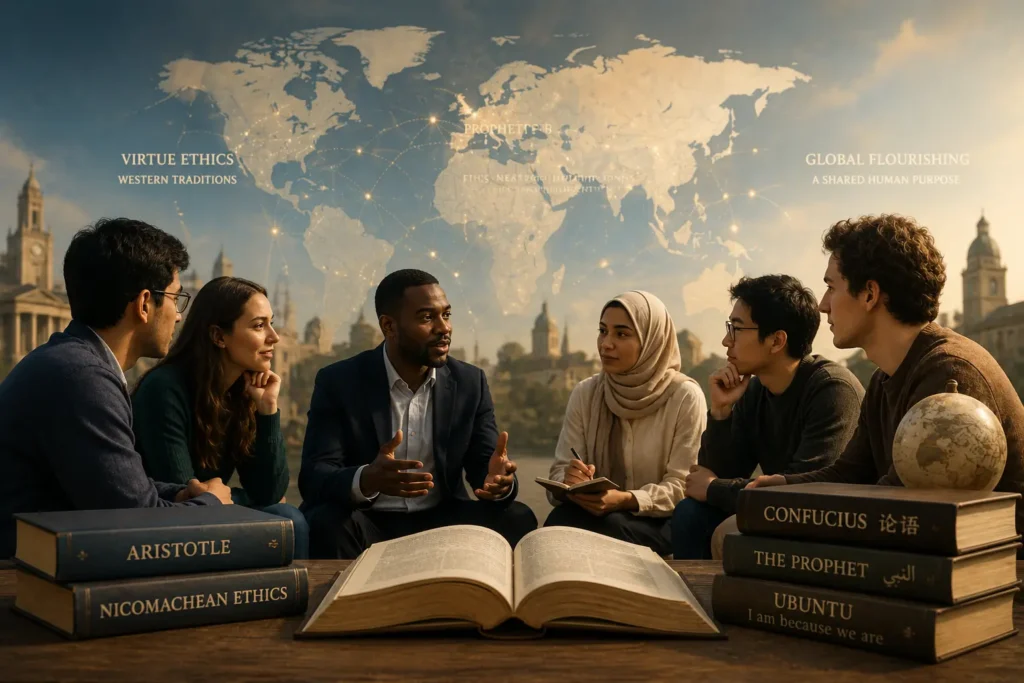
No single tradition possesses a monopoly on wisdom about human flourishing. Aristotelian, Confucian, Buddhist, Indigenous, Islamic, and other traditions each offer valuable insights into the formation of character and the pursuit of the good life.
The task before educators and scholars is not to replace one framework with another, but to build relational, conceptual, and institutional bridges that allow these traditions to learn from one another.
The work emerging from collaborations between institutions such as Superior University, the Jubilee Centre for Character and Virtues, and the Anteater Virtues Project represents an important step in this direction. Such partnerships demonstrate that global character education can become richer, more inclusive, and more relevant when it welcomes diverse virtue traditions into the conversation.
In an increasingly interconnected world, the pursuit of human flourishing may require not the dominance of a single philosophical framework, but a dialogue of traditions, each illuminating and strengthening the others in the shared quest to develop wise, virtuous, and responsible human beings.