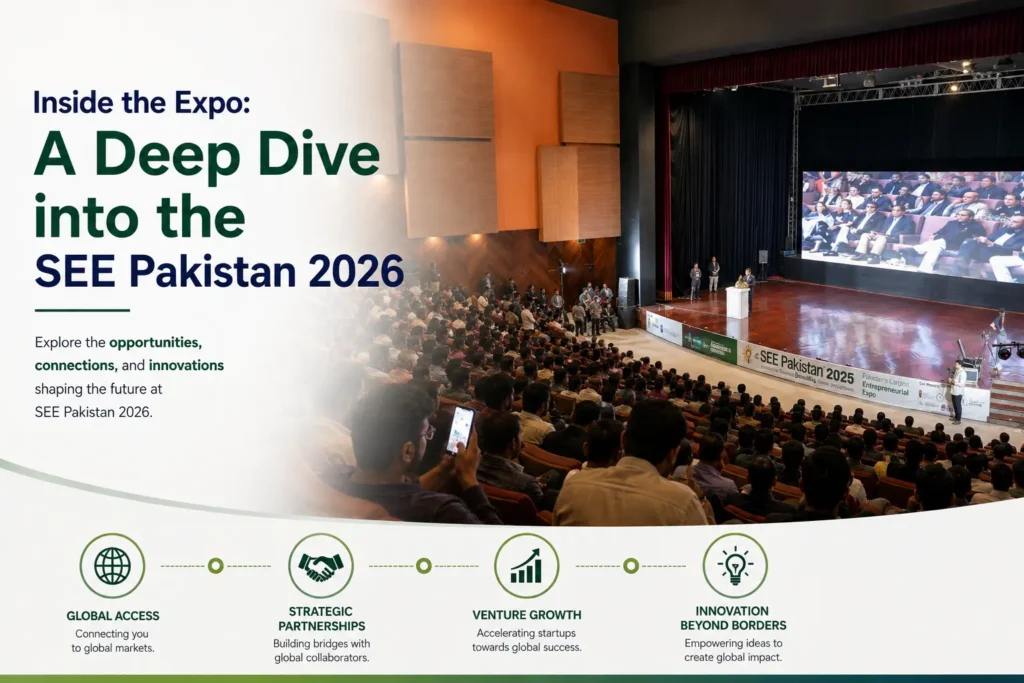
Where Business Meets Startup
The Corporate Industry is the connective tissue of SEE Pakistan 2026. It is designed specifically for B2B engagement — a space where participants share experiences, ideas, and problems with each other (SEE Pakistan, 2026). Marketers come to learn, analyse the industry, and benchmark against competitors. Business consultants provide guidance to early-stage founders. Corporate leaders scout for solutions, partnerships, and acquisition targets.
This matters because it is where the transaction layer of the expo operates. A startup that has built a supply chain tool, an enterprise SaaS product, or a B2B payments platform does not need retail customers — it needs corporate buyers. The Corporate Industry creates the conditions for those conversations to happen in person, with decision-makers in the room.
Pakistan's B2B software market is maturing. The ecosystem is moving away from consumer-facing burn-to-win models toward margin-rich B2B software and recurring revenue (huzi.pk, 2026). Major local banks including Meezan Bank and Standard Chartered Pakistan are actively partnering with or funding startups — signalling long-term institutional confidence in B2B tech (huzi.pk, 2026). The Corporate at SEE Pakistan is where that convergence between established institutions and startup innovation is most visible.
The AI & Deep Tech: Pakistan's $1 Billion National Bet
Artificial intelligence is no longer a niche interest in Pakistan. The Government of Pakistan has committed $1 billion toward AI and emerging technologies development, positioning the country as a regional AI innovation hub (jamalsohail.com, 2026). The National Centre of Artificial Intelligence (NCAI) has already developed 221 AI products across smart cities, precision agriculture, healthcare, manufacturing, and the judiciary (NCAI, n.d.).
At SEE Pakistan 2026, the AI and Deep Tech reflect this national ambition. Pakistan's top AI companies include Arbisoft (Lahore) in AI and machine learning services, 10Pearls (Islamabad) in generative AI implementation, and Folio3 (Karachi) in AI-powered AgriTech and enterprise solutions (LetTech, 2026). The startup pipeline feeding into SEE Pakistan includes ventures working on:
● Conversational AI — chatbots and enterprise customer support automation
● AI-powered credit scoring — alternative financial inclusion tools for unbanked populations
● AI-driven sign language recognition — accessibility technology for the deaf community
● Predictive diagnostics — AI-integrated healthcare solutions for under-resourced clinical settings
● B2B e-commerce AI — intelligence layers on top of existing marketplace infrastructure (jamalsohail.com, 2026)
The B2B opportunity is significant. Pakistani AI startups are no longer only building for domestic markets. Companies like Vyro.ai are winning globally, proving that Pakistan's engineering talent can produce AI products that compete internationally (huzi.pk, 2026). For international investors visiting SEE Pakistan 2026, the AI is where that export potential is most concentrated.
In 2025, fintech, healthtech, AI, and B2B SaaS attracted the most investor attention in Pakistan, with local startups raising over $74 million in total (Digital Pakistan, 2026). AI sits at the intersection of all four — making the AI arguably the highest-value segment of the entire expo for investors with a global mandate.
FinTech: Pakistan's Most Funded and Fastest-Moving Sector
Fintech is Pakistan's dominant startup sector by every measurable indicator. It accounts for 34% of all Q1 2026 deal flow and has dominated every year of Pakistan's funding cycle, including the contraction years (startup.pk, 2026a). The sector attracted $391 million in venture capital across 450 companies since 2015, and raised $52.5 million in just the first half of 2025 (startup.pk, 2026a).
The SEE Pakistan 2026 FinTech reflects a sector in rapid evolution. Early-stage startups at the are moving into:
● B2B payments infrastructure — invoicing, collections, supplier payments, and trade finance for Pakistan's massive SME economy
● Embedded finance — logistics startups that lend to merchants and drivers, creating sustainable recurring revenue
● Alternative credit — AI-powered platforms that use non-traditional data to score unbanked borrowers
● Payroll access — earned wage access products for blue-collar workers in manufacturing and retail
● Islamic fintech — Shariah-compliant financial products for a market where conventional finance is constrained by religious preference (blog.mean.ceo, 2026a)
The standout signal in this space is Haball, Pakistan's B2B payments leader, which has reported processing above $3 billion in transactions and raised a $52 million hybrid pre-Series A round — the largest early-stage fintech raise in Pakistan's history (blog.mean.ceo, 2026b). Haball demonstrates exactly what the FinTech at SEE Pakistan is producing: startups that have moved from concept to infrastructure at national scale.
For B2B buyers, the FinTech offers access to payment digitisation tools, trade finance solutions, and financial management platforms that can be integrated into existing business operations. For investors, it is the deepest pool of fundable ventures in the expo.
AgriTech: Feeding a Nation, Building an Export
Agriculture contributes approximately 19% of Pakistan's GDP and employs around 37% of its workforce (World Bank, 2025). Pakistan is the world's fourth-largest cotton producer, fifth-largest sugarcane producer, and a major exporter of rice, wheat, and mangoes. Yet productivity losses from outdated practices, supply chain inefficiencies, and climate volatility cost the sector billions annually.
The SEE Pakistan 2026 AgriTech is where that gap meets technology. Pakistan has 125 AgriTech startups, 22 of which are funded (Tracxn, 2026b). The strongest product categories in 2026 are farm management software, remote sensing, smart irrigation, drone-based crop monitoring, and supply chain traceability (blog.mean.ceo, 2026c).
Pakistani AgriTech startups exhibiting at SEE Pakistan include ventures working on:
● AI-powered crop monitoring — AIGROS centralises farm, climate, and satellite data into a unified cloud. Its platforms provide hyperlocal weather forecasting, pest intelligence, and satellite-based crop health analytics (StartUs Insights, 2026). Crop2X has been providing AI-driven, data-based crop monitoring for over eight years, combining AI with soil, land, and weather condition insights (Geo.tv, 2026)
● Precision farming platforms — IoT-based soil sensors, drone surveillance, and AI-driven pest control tools that reduce input costs by up to 20% and boost yields by as much as 30% (The Agricultural Economist, 2025)
● Digital farmer-to-market connections — B2B fresh produce marketplaces connecting smallholder farmers directly to food businesses, cutting out costly intermediaries
● Farm input procurement — mobile platforms for fertiliser, seed, and equipment procurement combined with crop advisory and market price data
The B2B opportunity in AgriTech is two-directional. Domestically, corporate food processors, exporters, and agribusinesses need the supply chain visibility and quality consistency that these platforms provide. Internationally, agricultural technology buyers in water-scarce and climate-vulnerable markets — the Middle East, Central Asia, and East Africa — are actively looking for affordable, proven solutions that work in low-data environments. Pakistani AgriTech startups, built to operate with constrained resources, are well-suited to compete in those markets (Digital Pakistan, 2026).
HealthTech: Building the Clinic Pakistan Cannot Afford to Build
Pakistan has approximately one doctor per 1,000 patients — far below the WHO recommended ratio of one per 500 (WHO, 2024). Rural health infrastructure is severely under-resourced. Out-of-pocket health spending is high. Diagnostic services are concentrated in major cities.
HealthTech at SEE Pakistan 2026 addresses these gaps directly. The sector attracted serious investor attention in 2025, with MedIQ securing a $6 million Series A — demonstrating that HealthTech can attract institutional capital in Pakistan (blog.mean.ceo, 2026b). Startups in the HealthTech are working on:
● Care navigation platforms — tools that help patients find, book, and manage healthcare appointments across fragmented provider networks
● Employer health plans — B2B health benefits management for Pakistan's growing corporate sector
● Diagnostics coordination — platforms that digitise lab referrals, test results, and follow-up care, reducing the friction between diagnosis and treatment
● Pharmacy logistics — supply chain tools for pharmaceutical distribution across Pakistan's dispersed retail pharmacy network
● AI-driven diagnostics — machine learning applications for early disease detection, particularly in contexts where specialist access is limited (jamalsohail.com, 2026)
The B2B opportunity here is significant for insurers, hospital networks, pharmaceutical companies, and employers. Each of these institutions needs better data, better coordination, and better access to patient populations — all of which HealthTech startups at SEE Pakistan are building.
What all this Add Up To
Taken together, SEE Pakistan 2026 represent something Pakistan has rarely had: a single, curated, well-structured view of its most promising sectors — presented simultaneously to domestic buyers, international investors, policymakers, and media.
For a B2B buyer from Karachi, it is the most efficient way to find and evaluate vendor solutions across AI, fintech, agritech, healthtech, and education technology in a single day. For an international investor from Singapore, Dubai, or London, it is a structured entry point into Pakistan's startup economy — with the credibility of the World Startup Championship evaluation process behind every startup on the floor.
For Pakistan, it is evidence that the country's innovation economy has matured beyond hype into structured, sector-specific depth. And in 2026, that marketplace is open for business.
References
● blog.mean.ceo. (2026a, June). Startups in Pakistan news — June 2026. https://blog.mean.ceo/startups-pakistan-news-june-2026/
● blog.mean.ceo. (2026b, August). Startups in Pakistan news — August 2026. https://blog.mean.ceo/startups-pakistan-news-august-2026/
● blog.mean.ceo. (2026c, June). AgriTech news — June 2026. https://blog.mean.ceo/agritech-news-june-2026/
● Digital Pakistan. (2026, June 20). Pakistan's AI ecosystem in 2026: Startups, software, and more! https://digitalpakistan.pk/pakistan-ai-ecosystem
● geo.tv. (2026, March 27). Agritech isn't a magic wand — but Pakistan may need one. https://www.geo.tv/latest/657392-agritech-isnt-a-magic-wand-but-pakistan-may-need-one
● huzi.pk. (2026). Key Pakistani startups to watch in 2026. https://huzi.pk/blog/guides/key-pakistani-startups-watch-2026
● Ignite — National Technology Fund. (n.d.). pk. https://ignite.org.pk/
● jamalsohail.com. (2026, February 18). AI startups in Pakistan: Powering the country's $1 billion AI vision. https://jamalsohail.com/ai-startups-in-pakistan/
● lettech (2026, May 18). Top AI and tech companies in Pakistan 2026. https://lettech.pk/blog/top-ai-tech-companies-pakistan-2026
● National Centre of Artificial Intelligence. (n.d.). About NCAI. https://ncai.pk/
● SEE Pakistan. (2026). SEE Pakistan 2026 — World Startup Championship 2026 [Official website]. https://seepakistan.com.pk/
● StartUs Insights. (2026, February 26). 10 AgTech solutions to watch in 2026. https://www.startus-insights.com/innovators-guide/agtech-solutions/
● startup.pk. (2026a, May 12). Where startup capital is actually going in Pakistan right now. https://startup.pk/where-startup-capital-is-actually-going-in-pakistan-right-now/
● The Agricultural Economist. (2025, April 14). Transforming agriculture startups in Pakistan. https://agrieconomist.com/transforming-agriculture-startups-in-pakistan
● Tracxn. (2026a). Startups in Pakistan — 2026 latest funding rounds, trends and news. https://tracxn.com/d/geographies/pakistan/
● Tracxn. (2026b, January). Top startups in AgriTech in Pakistan. https://tracxn.com/d/explore/agritech-startups-in-pakistan/
● World Bank. (2025). Pakistan — Agriculture overview. https://www.worldbank.org/en/
country/pakistan/overview
● World Health Organization. (2024). Pakistan health system profile. https://www.who.int/countries/pak/