The Funding Gap That Makes $10,000 Matter
Pakistan's startup ecosystem has raised over $4.77 billion across all funding rounds since its inception (Tracxn, 2026). That sounds like a lot. It is not, when you look at who is getting it.
Equity funding recovered modestly in 2025, rising to $36.6 million from $22.5 million in 2024. The average disclosed equity deal size stood at roughly $3.7 million. That is the average. For a first-time founder with a working prototype but no revenue, no track record, and no investor connections, that number is irrelevant. The deals being done at that size are going to founders who have already passed the earliest and hardest stage.
In 2023, total disclosed startup funding fell by 77% from 2022, reaching $75.6 million, notably impacting early-stage ventures where seed funding almost dried up. Many startups downsized or shut down entirely during that period — not because their ideas were bad, but because they ran out of runway before they could prove themselves.
Pakistan does not have a startup talent problem. It has a startup infrastructure gap. The gap is most acute at the very beginning — the pre-seed and early-seed stage, when a founder needs just enough money to validate a product, hire one developer, run a pilot, or attend a market-testing event.
That is exactly where $10,000 USD lands.
What $10,000 USD Actually Buys
In Pakistan's current economic context, $10,000 USD is not symbolic. It is operational. Here is what it can realistically fund for an early-stage startup:
Product development
A functional MVP built by a local development team costs between PKR 500,000 and PKR 1,500,000 depending on complexity. The prize covers this in full — allowing a founder to move from a pitch deck to a working product without taking on debt or giving away equity.
Market validation
Running a three-month pilot — hiring one business development person, covering travel to client meetings, and running basic digital marketing — costs approximately PKR 300,000 to PKR 600,000. This is the difference between a startup that has paying customers and one that is still guessing.
Legal and registration costs
SECP company registration, trademark filing, and basic legal structuring cost between PKR 50,000 and PKR 150,000. Many early-stage founders delay formalising their business because of these costs. The prize removes that barrier.
Operational runway
For a lean two-person team, PKR 2.8 million provides three to four months of operational runway — enough time to reach the kind of traction that opens doors to the next stage of funding.
This is not hypothetical. Pre-seed funding globally is used for idea validation, typically in the range of $500,000 to $1 million. At $10,000, the SEE Pakistan prize sits exactly at the threshold where it can fund the specific activities — prototype, pilot, registration, runway — that a startup needs to graduate from idea to early traction.
The Ecosystem Context: Why This Prize Is Rare
The growth-stage funding gap remains the central constraint in Pakistan's startup ecosystem. Seed and pre-Series A capital has survived the global pullback reasonably well, but the very earliest stage remains underserved.
Most incubation programmes in Pakistan offer workspace, mentorship, and connections — but not unrestricted cash. The NIC network offers equity-free grants, but these are competitive, process-heavy, and not accessible to every founder at the very beginning of their journey (startup.pk, 2026). Angel investors exist but are concentrated in Lahore, Karachi, and Islamabad, and typically write cheques only after a startup has demonstrated early traction.
Pakistan's startup ecosystem contends with macroeconomic uncertainty, regulatory complexity, limited early-stage capital, and talent shortages. For a founder from Sialkot, Gujrat, or Narowal — cities that are producing more university graduates every year — access to an angel investor or VC is not a realistic first step. Access to a competition with a credible cash prize is.
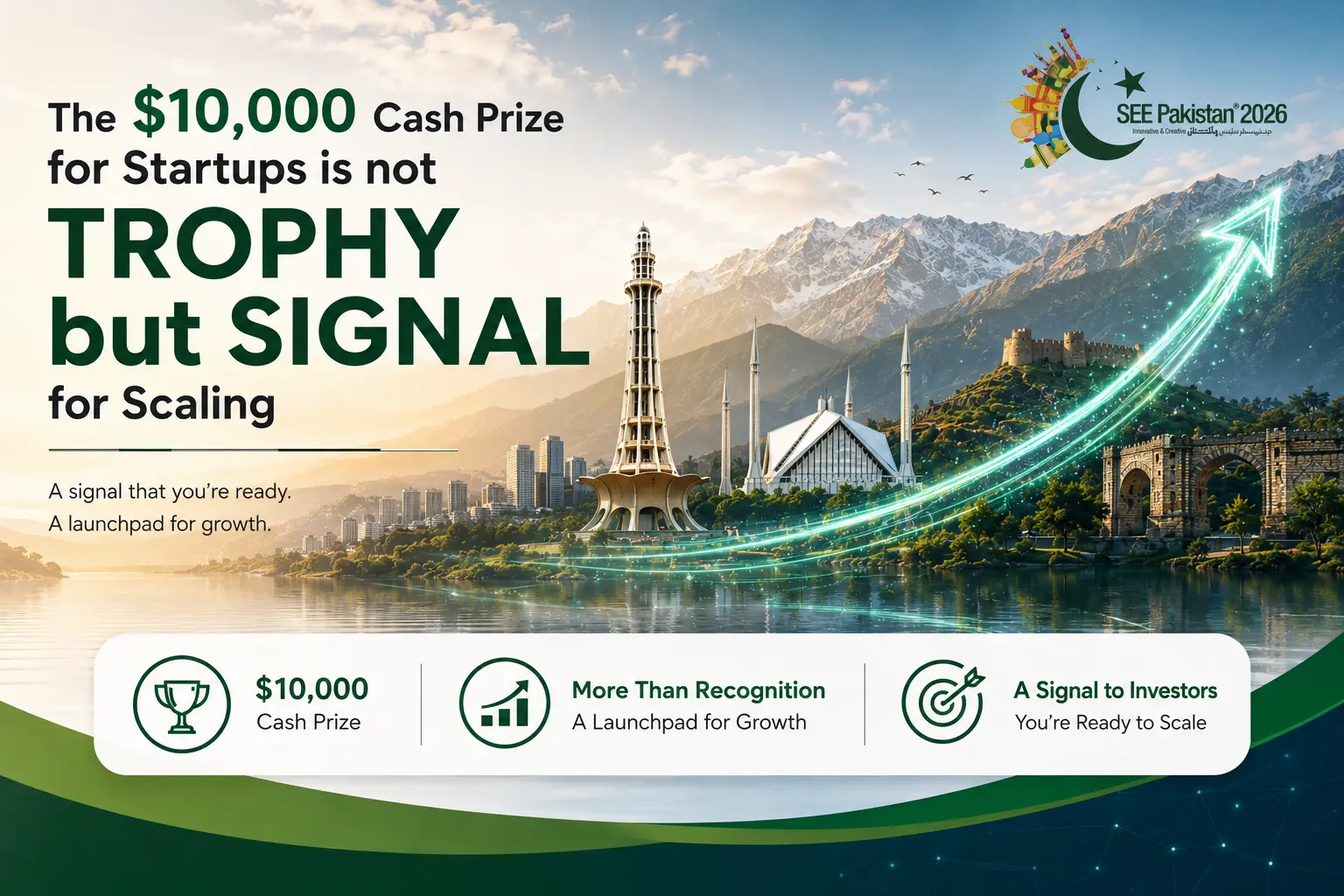
SEE Pakistan is the only innovation expo in Pakistan offering $10,000 USD as a prize (SEE Pakistan, 2026). That is not a small distinction. It is a structural contribution to the ecosystem — filling a gap that the market is not yet filling on its own.
Prize Money as a Signal, Not Just a Sum
The $10,000 USD prize does something beyond funding a startup's next three months. It sends a signal.
When a startup wins SEE Pakistan, it is not just collecting money. It is collecting a credential. The prize validates the startup in front of investors, industry partners, and potential customers who were watching. It is public, announced on social media, and tied to a rigorous evaluation process that scores startups against criteria including innovation, market potential, scalability, financial viability, and execution capacity (Evaluation Forms WSC-SEE Pakistan, 2026).
Capital became more selective in 2025, filtering out hype-driven ventures while strengthening founders focused on solving real-world problems. In that environment, having won a credible, structured competition matters when a founder walks into a room with an investor. It is evidence of external validation — something investors consistently look for at the early stage.
The prize also connects winners to the World Startup Championship 2026 — an international competition that provides access to global investors, cross-border mentors, and an international founder community (SEE Pakistan, 2026). For a Pakistani startup, international exposure at this stage is not a luxury. It is a competitive advantage that almost no other domestic event offers.